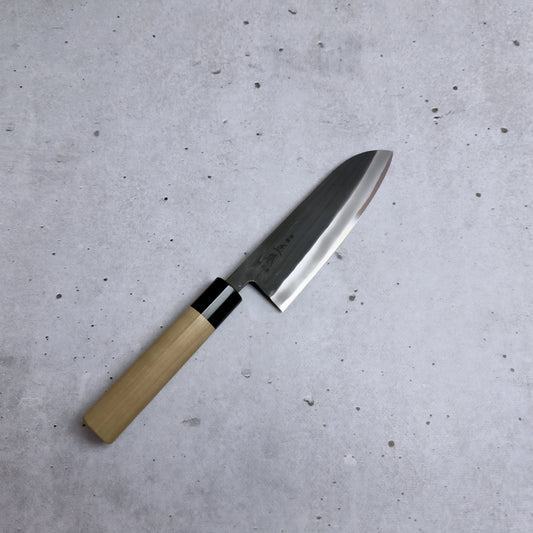
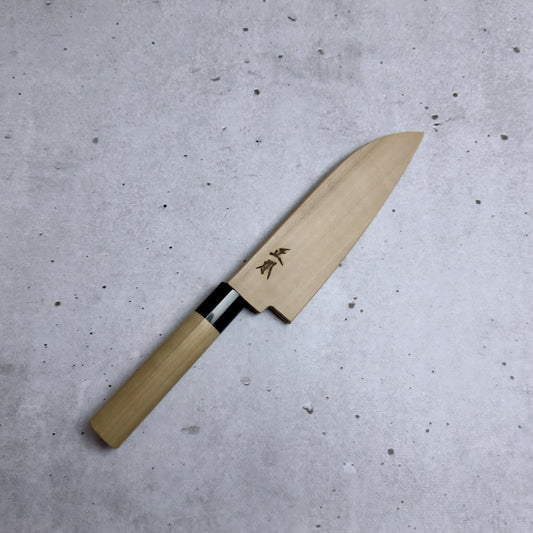
Profile History
The Santoku was born in Japan in the 20th century, during a period of intense urbanization and lifestyle changes.
After World War II, kitchens became smaller, and cooking became more practical and everyday.
There was a need for a knife that:
- would fit on a shorter cutting board
- would be comfortable for various users
- could handle most ingredients
Thus, the Santoku was created – a Japanese kitchen knife combining functionality with a compact form.
It was not a ceremonial knife or a symbol of hierarchy, like the Kiritsuke – master profile.
It was a tool for everyday work.
Meaning of the Name
The word "santoku" (三徳) literally means "three virtues" or "three uses."
In practice, it refers to working with:
It is this versatility that has made the Santoku one of the most popular Japanese knives in the world.
Technical Characteristics
The Santoku is distinguished by:
- a shorter blade (most often 165–180 mm)
- a wide blade
- a gently rounded spine line
- a relatively flat cutting edge
Compared to a gyuto, the Santoku has:
- a smaller reach
- a more compact balance
- a shorter, controlled cutting motion
This makes it comfortable in smaller kitchens and for people who prefer stability over blade length.
Geometry and Steel
The Santoku, like other Japanese knives, can be made from:
- White Steel (Shirogami)
- Blue Steel (Aogami)
- modern high-hardness stainless steels
The thin geometry promotes clean slicing and minimal resistance.
Regular sharpening on water stones allows for maintaining high cutting precision.
Santoku in Modern Kitchen Culture
The Santoku has become a symbol of modern Japanese cuisine — practical, precise, but without excessive formalism.
It does not require advanced technique like the Kiritsuke.
It is not as long as the Gyuto.
It is a tool of compromise — between tradition and convenience.
What is the Santoku used for?
The Santoku is excellent for:
- slicing vegetables
- portioning meat
- working with fish
- everyday cooking
The wide blade makes it easy to transfer chopped ingredients from the board.
What is it not intended for?
The Santoku is not used for:
- chopping bones
- working with frozen products
- forceful chopping
It cannot replace a specialized Nakiri – Japanese vegetable cleaver for intensive work with plant-based products.
Who is the Santoku for?
The Santoku is chosen by people who:
- are looking for one convenient knife for everyday cooking
- work in a smaller space
- prefer a shorter blade
- are beginning their adventure with Japanese knives
For more advanced users, the natural next step might be a Gyuto – Japanese chef's knife or a Kiritsuke – precision profile.
See Also