History and Origin
The Nakiri knife originated in the home kitchens of the Edo period (1603–1868), when cooking was strongly tied to seasonality and local agriculture.
Unlike knives used in professional samurai or court kitchens, the Nakiri was an everyday tool.
It was used for preparing vegetables, which formed the foundation of the diet in many regions of Japan.
The name "nakiri" can be translated as "leaf cutting knife" – which directly refers to working with vegetables, herbs, and plants.
This profile arose not from a need for prestige, but from the need for repeatability and clean cuts.
Technical Characteristics
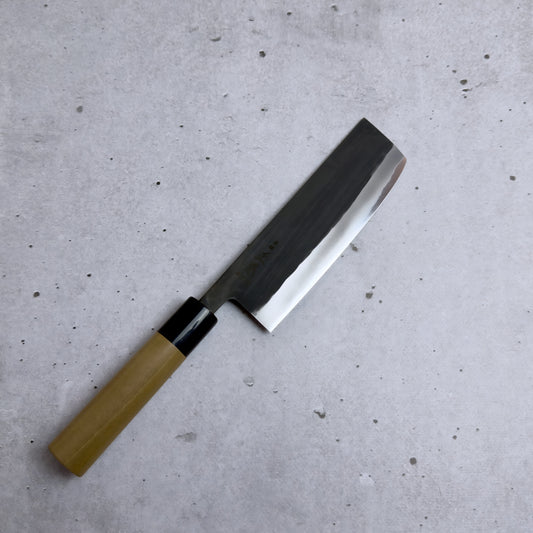
The Nakiri is distinguished by:
- a straight, flat cutting edge
- a wide blade
- a lack of a pronounced tip
- a thin blade geometry
The straight blade line ensures that with each stroke, the entire edge makes contact with the cutting board.
This allows for even and precise cutting.
Compared to the Santoku - a Japanese all-purpose knife, the Nakiri has an even flatter profile and is specifically dedicated to vegetables.
Typical length is 165–180 mm.
Geometry and Steel
Nakiri, like other Japanese knives, can be made from:
- White Steel - valued for its purity and sharpness
- Blue Steel - with increased edge retention
- modern stainless steels
The thin cutting edge allows for cutting without crushing the structure of vegetables.
This is important not only aesthetically but also culinarily – preserving the structure affects texture and flavor.
Regular sharpening on knife sharpening stones allows for maintaining high precision in work.
Nakiri in the Culture of Plant-Based Cuisine
In traditional Japanese cuisine, the processing of seasonal vegetables was of great importance.
Even slices of daikon radish, thinly sliced cabbage, or precisely prepared herbs were an expression of attention to detail.
The Nakiri was created in response to this need.
It is not a ceremonial knife like the Kiritsuke - master profile.
It is a tool focused on repeatability and control.
What is the Nakiri used for?
The Nakiri excels at:
- slicing vegetables
- shredding cabbage
- working with herbs
- dicing
- preparing plant-based products
The wide blade facilitates transferring chopped ingredients from the board.
What is it not intended for?
The Nakiri is not used for:
- chopping bones
- working with frozen products
- portioning meat
Its thin geometry is not designed for forceful contact with hard structures.
Who is the Nakiri for?
The Nakiri is chosen by people who:
- frequently work with vegetables
- prefer a vertical cutting technique
- value repeatability and clean cuts
- run a plant-based or seasonal kitchen
If you are looking for an all-purpose knife for meat and fish, a Gyuto - Japanese chef's knife or Santoku - all-purpose knife would be more suitable.
See also