Profile History
The Gyuto originated during the Meiji period (1868–1912), when Japan ended its isolation and began to modernize intensely under Western influence.
For over a thousand years, Japanese cuisine relied mainly on fish and vegetables. Meat consumption – especially beef – was marginal. It was only with the opening of the country and changes in customs that the need arose for a knife adapted for portioning larger cuts of meat.
The name gyuto (牛刀) literally means "beef knife."
This was the Japanese blacksmiths' response to the Western chef's knife, but the adaptation was not a mere copy of the form.
The idea of versatility was retained, but the geometry was changed:
- the blade became thinner
- the steel – harder
- the balance – more precise
- the profile – more subtle in handling
During the same period, many craftsmen stemming from the sword-making tradition (katana-kaji) began to apply their skills to kitchen knives.
The precision of the grind, control over the sharpening angle, and the approach to steel hardening were a natural continuation of the blade culture present in Japan for centuries.
The Gyuto became a symbol of the transition from tradition to modernity – preserving craftsmanship but adapting to new needs.
Technical Characteristics
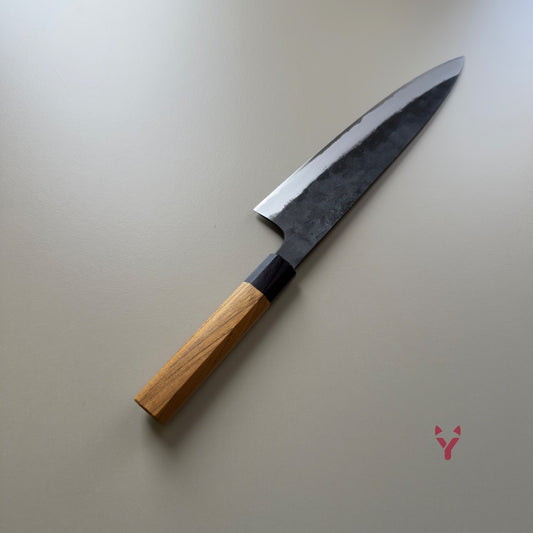
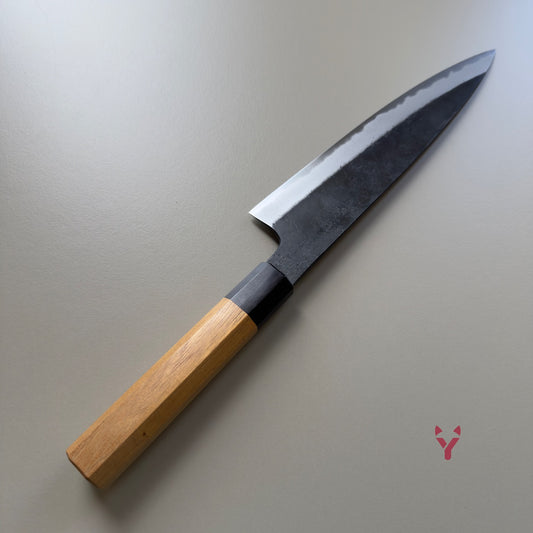
The Gyuto is distinguished by:
- a slender, elongated profile
- a pronounced tip for precise work
- a long, fluid cutting line
- a thin geometry conducive to clean slicing
Unlike many Western knives, the gyuto is not designed for forceful chopping.
Its strength lies in controlled cutting motion and minimal blade resistance.
Typical lengths of 180–300 mm allow the knife to be matched to:
- hand size
- workspace
- working style
In Japan, a length of 210 mm is considered the most versatile, while 240 mm is preferred by professionals working with larger products.
Craftsmanship and Steel
Depending on the manufacturer, a gyuto can be made from:
- White Steel (Shirogami) – pure, reactive, valued for its sharpness,
- Blue Steel (Aogami) – enriched with alloy additives for better retention
- high-hardness stainless steels
In kasumi or san-mai construction, a hard core is surrounded by softer layers, providing a balance between sharpness and stability.
This approach directly stems from techniques used in sword making – where the core and cladding served different structural functions.
Gyuto in Japanese Culinary Culture
The modern Gyuto is a chef's tool that combines tradition with modernity.
It won't replace specialized sashimi or fish filleting knives, but it forms the foundation of daily work.
In many professional kitchens in Japan, the gyuto is the first knife taken out of its sheath and the last put away after work is done.
It is a tool of compromise – between tradition and adaptation, between strength and precision.
Who is the Gyuto for?
The Gyuto is chosen by those who:
- want to work with one main knife
- value thin geometry and control
- are willing to care for a high-carbon blade
- are looking for a versatile tool
It is not a knife for chopping bones or working with frozen products.Its purpose is clean, conscious cutting.