History and significance in Japanese cuisine
The kiritsuke originates from professional kitchens of the Edo period (1603–1868), which had a clear hierarchy of positions.
In a classic sushi or kaiseki restaurant, only the head chef was allowed to use a kiritsuke knife.
It was a symbolic tool — combining competence and responsibility.
The kiritsuke profile is inspired by a combination of:
- usuba (vegetable knife)
- yanagiba (sashimi knife)
The modern version, available in Western kitchens, often appears as a kiritsuke gyuto — a Japanese chef's knife with a kiritsuke geometry.
This is an important distinction:
Kiritsuke is not merely an aesthetic variation. It is a profile with a specific working philosophy.
Meaning of the name
The word "kiritsuke" (切付) can be understood as "cutting with application" or "cutting with precision".
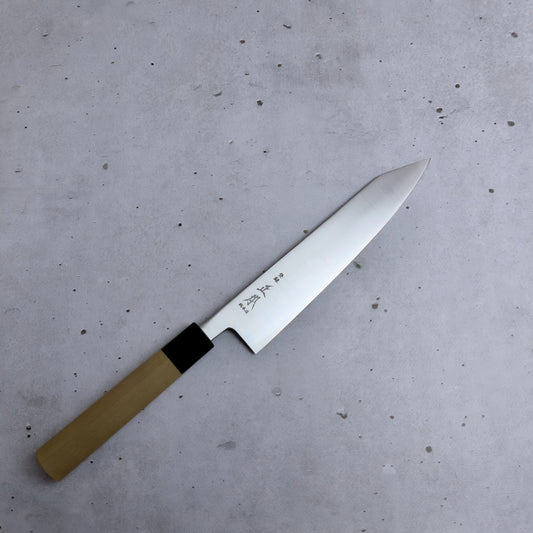
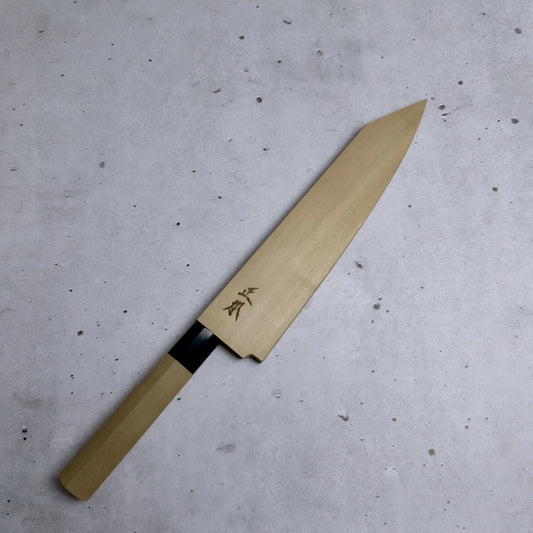
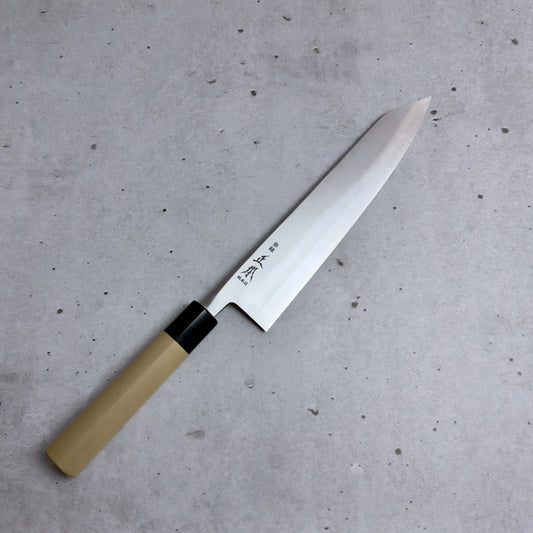
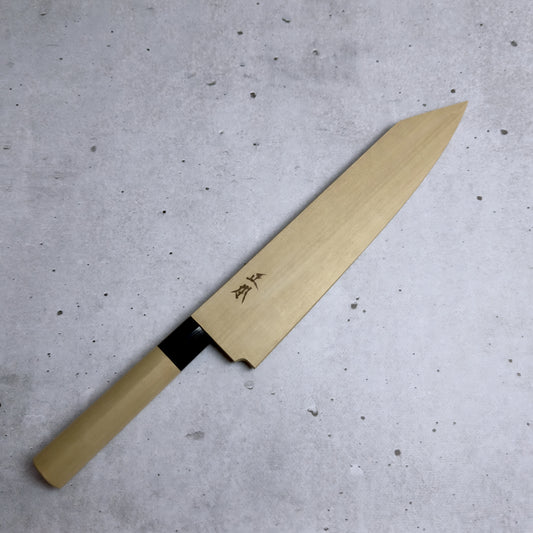
The characteristic reverse tanto tip allows for very precise blade control when portioning fish and for detailed work.
Technical characteristics
The kiritsuke is distinguished by:
- a straight spine line
- a long, flat cutting edge
- a distinct, sharp tip
- a thin geometry that promotes precise cutting
Compared to a Gyuto – Japanese chef's knife, the kiritsuke profile is more demanding and less tolerant of technical errors.
Typical lengths are 210–270 mm.
In professional kitchens, 240 mm and longer models are preferred.
Steel and construction
Kiritsuke is often made from:
- White Steel (Shirogami)
- Blue Steel (Aogami)
- high-carbon stainless steels
The hardness of the blade translates to:
- a clean, linear cut
- high edge retention
- the need for regular sharpening on whetstones
Its thin geometry means that the kiritsuke is not a knife for chopping or for contact with bone.
Kiritsuke in blade culture
In Japanese tradition, a tool reflects the level of responsibility.
The kiritsuke was the chef's knife not only because of its functionality but also its symbolism.
Using it meant that the chef had mastered the technique, understood the product's structure, and could guide the blade without excessive force.
It is a tool that requires focus.
Unlike the more versatile Santoku – all-purpose knife, the kiritsuke is not designed as a compromise.
It is a tool of conscious choice.
What is kiritsuke used for?
Kiritsuke excels at:
- portioning fish
- slicing meat thinly
- precise vegetable cutting
- detailed work with the tip of the blade
The long cutting line allows for clean, uniform movements without "sawing."
What is it not designed for?
Kiritsuke is not for:
- chopping bones
- working with frozen products
- forceful chopping
Its construction is based on precision, not impact resistance.
Who is kiritsuke for?
Kiritsuke is chosen by people who:
- have experience with Japanese knives
- work consciously and control the blade's movement
- appreciate a long, flat cutting line
- are looking for a professional-grade tool
For those starting their journey with Japanese blades, a Gyuto – Japanese chef's knife or Santoku – all-purpose knife might be a more natural choice.
See also